Dutchie Connect
Dutchie — B2B SaaS — Web
Project Overview
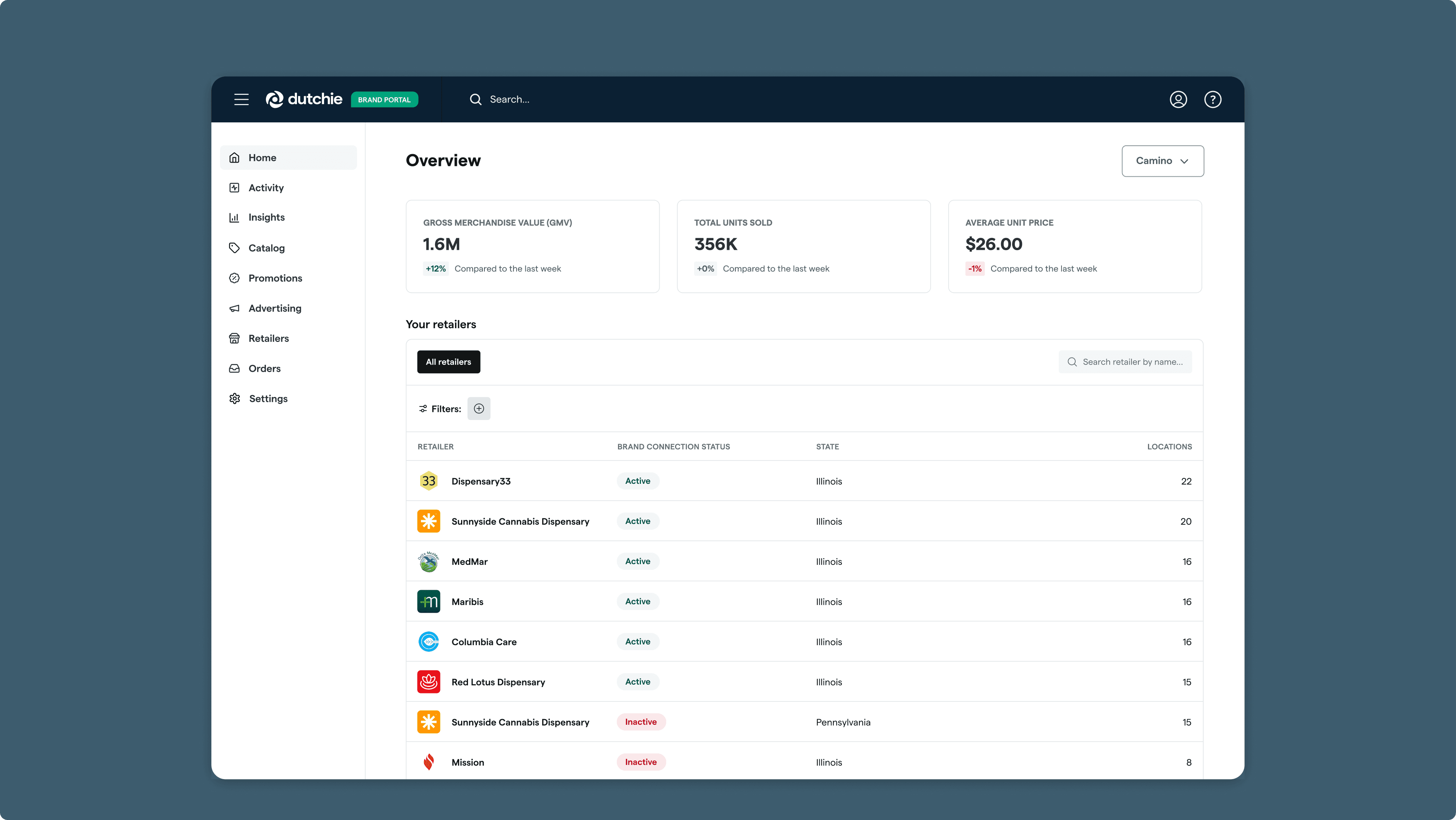
Dutchie Connect is an enterprise ecosystem designed to bridge the structural gap between cannabis brands and retailers. Prior to this initiative, Dutchie's brand presence was strictly restricted to a passive ad-upload utility, forcing brands and dispensaries to navigate their core operational relationships entirely through manual channels like phone calls, text messages, and unorganized spreadsheets.
As the lead Product Designer on this pre-alpha initiative, I spearheaded the end-to-end design strategy for the Brand Portal while simultaneously architecting the integration patterns for the Retailer-facing platform. I collaborated closely with a Product Manager, engineering teams, and a secondary product designer whom I mentored and led through the extension of our procurement features.
The Legacy State: High-Friction, Siloed Workflows
Initially, Dutchie’s brand portal functioned merely as an administrative tool where brands uploaded product details to feed into a third-party advertising system (Moloco). It lacked any direct connection to the retailers who actually sold those products. This resulted in massive operational blindness and friction across three core areas:
Siloed Cataloging & Asset Chasing: Dispensaries had to manually create products within their point-of-sale systems from scratch. Retailers spent hours chasing brand representatives over email to request imagery and description assets, or resorted to manually scraping brand websites.
The Promotion Accountability Nightmare: Brand-funded promotions were a financial black box. There was no shared source-of-truth between parties. Operators were forced to manually audit sales data over Excel spreadsheets to argue over balances (e.g., "I sold X amount of your product," "You owe me $X," "You applied this credit, so you only have $X remaining").
Lack of Access to Brand-facing Insights: Retailers manually compiled product performance sheets and purchase orders to email them over to brands, leaving brands with no real-time understanding of market demand or inventory depletion rates.
The Goal
Transform a passive tool into a unified, two-sided B2B marketplace hub. The system needed to provide brands with deep performance analytics, streamlined catalog sharing, and promotional management tools, while seamlessly embedding direct catalog imports, purchase order routing, and granular data-privacy guardrails into the existing retailer interface.
Discovery & Validation
Consulting the Market Leaders
We did not architect this network in a vacuum. To map the true operational workflows and financial friction points between brands and dispensaries, I co-led initial discovery syncs with major enterprise market leaders, including:
Jeeter: Our most frequent design partner, and the #1 cannabis pre-roll brand in the United States.
Fernway: A premier, fast-growing vape and flower brand dominating the Northeast market with highly complex retail partner networks.
These initial sessions were critical for uncovering how business was actually conducted behind the scenes, revealing the informal verbal agreements, text message chains, and manual Excel auditing models that defined the status quo.
How We Divided Work
Once we figured out the basic structure of how the system would work, the PM and I split up our day-to-day tasks so I could focus entirely on designing:
Early Phase: I actively partnered with the Product Manager to lead user interviews that helped us align on product requirements.
Execution Phase: Once the foundational parameters were set, I shifted entirely to building out the design and mapping the workflows across both portals.
The Feedback Loop: To keep me unblocked, the PM took over the weekly check-ins with our brand partners. He handled the client meetings and brought their feedback straight back to my drawing board so I could iterate fast.
Dual-Portal Architecture
Because Dutchie Connect required building a brand-new marketplace network from scratch, the product scope spanned both brand-facing and retailer-facing environments. To maximize impact and eliminate manual offline overhead, We decided to anchor the design deep-dives around the three most critical operational pillars of the network:
Bidirectional Ordering (Purchase Orders)
A two-sided purchase order (PO) workflow was targeted to standardize the entire wholesale buying cycle.
The Retailer-Facing Builder: An interface that allows dispensaries to browse active brand catalogs, track past ordering, and create a purchase order directly within their existing platform.
The Brand-Facing Fulfillment Engine: An interface that surfaces submitted orders to the brand allowing them to accept, modify, or track shipping status.
Negotiations: Any changes to POs are able to be reviewed by each party creating a clear back-and-forth channel of communication.
The Financial Boundary: Because Dutchie does not function as a money-movement platform, our engine intentionally stopped short of payment processing. Instead, the digital PO functioned as a binding operational agreement, leaving actual capital settlement to continue via the users' existing offline channels (e.g., ACH wires or Cash on Delivery).

Gated Inventory Insights
Brands wanted real-time retail inventory data to optimize their supply chain and manufacturing schedules, but retailers were highly protective of their sales metrics.
The Privacy Gate: To build trust, I designed a brand connection control center for retailers featuring explicit data-sharing toggles.
Data Visibility: If a retailer opted out of data sharing, the brand's dashboard displayed general inventory statuses but hid specific inventory counts and velocity metrics. I used a status icon to indicate whether a brand opted into data sharing.

Brand-Funded Promotions & Credit Ledger
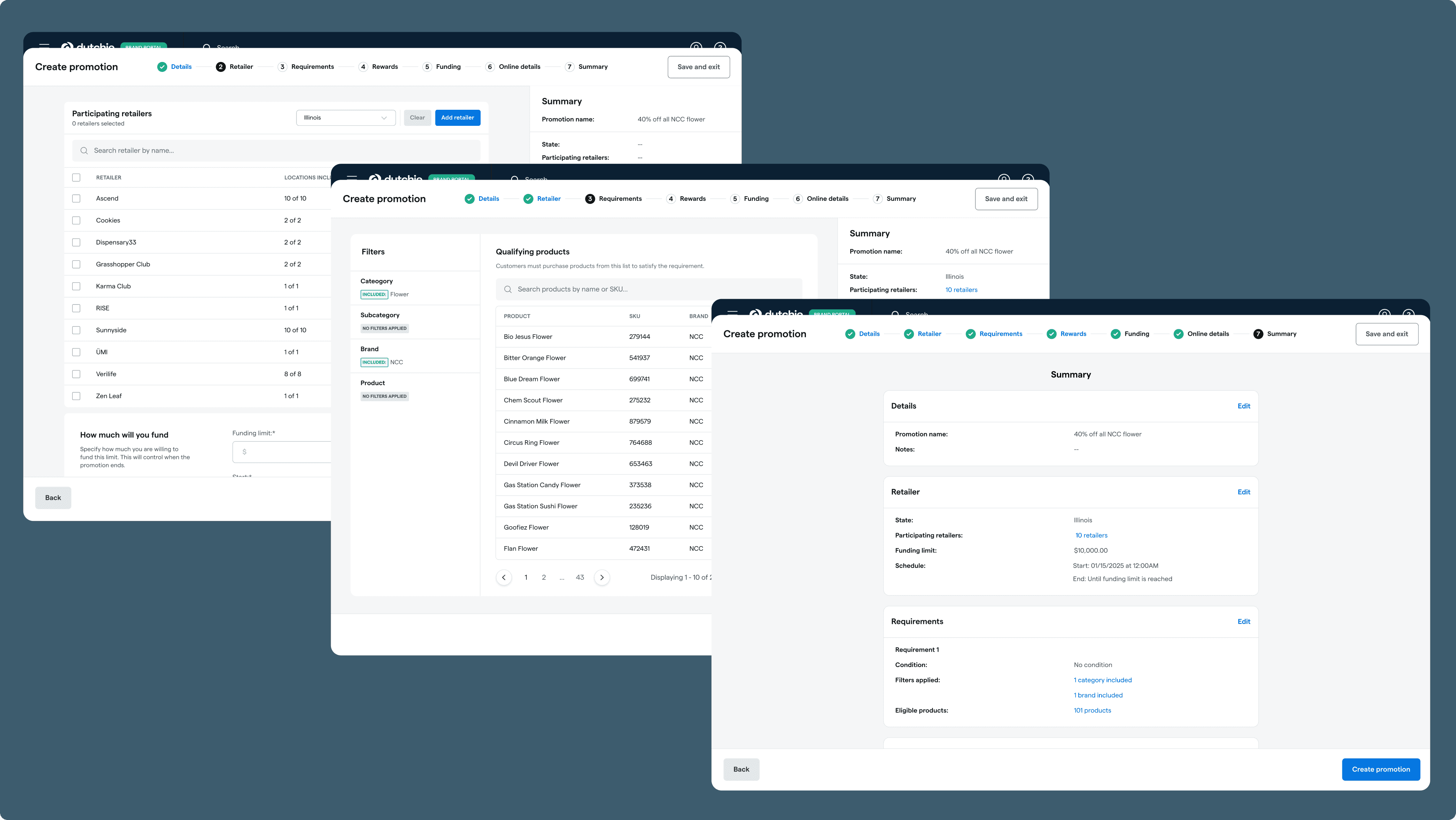
Running multi-store promotional campaigns used to require endless phone calls and emails. To centralize this workflow, I built a unified creation tool on-platform, reusing structural patterns from my Discount Wizard designs to move quickly and keep the ecosystem consistent. By replacing the manual communication up front, the system automatically tracks campaign performance and displays real-time credit balances—completely eliminating the need for end-of-month Excel audits.
Brand Setup: Brands can launch promotions targeted down to a specific store location and choose exactly how to fund them (like a flat discount rate or a fixed dollar amount per item sold).
Retailer Acceptance: Dispensaries can review and accept these offers right inside their portal. Once live, the discounts apply automatically at the point-of-sale.
The Ledger Payoff: A real-time ledger tracks exactly how many products were sold and the exact credit balance earned. While Dutchie doesn’t physically move the money, this automated ledger gives both sides a single source of truth to instantly settle up offline without manual audits.
Design Leadership & Collaborative Scaling
Scaling the Work
Because designing both portals simultaneously was a massive lift, leadership brought in another designer to help us hit our pre-alpha milestones. Since they were completely new to this complex B2B space, I took on a mentorship role to get them up to speed without losing design consistency. I walked them through the core UX architecture I’d already built for the brand side so they could mirror those patterns on the retailer purchase order flow, and used our weekly PM syncs to review their screens, and ensure both sides of the marketplace connected seamlessly.
Project Impact, Reflections & Pre-Alpha Takeaways
The Reality of Pre-Alpha & Layoffs
Mid-way through the active design and development of this ecosystem, Dutchie underwent a restructuring phase that resulted in a layoff, impacting my role while the project was in its pre-alpha stage.
While the platform did not reach public deployment before my departure, the foundational work was handed off mostly prepared for development.
The Design Blueprints: I delivered the core designs for both the Brand and Retailer portals, giving the team a functional starting point for the network hub strategy.
Technical Agreement: We aligned with engineering and product on how the data privacy and credit tracking would work under the hood, making sure the main logic was vetted before development work started.
Asynchronous Documentation: Throughout the project, I proactively created detailed recordings to document design choices, complex interactions, and open logic items. Because the team was eventually dismantled, this library became the definitive guide for the PM and whoever inherits the project next.
Key Takeaways
Design for Trust First: In two-sided B2B marketplaces, data access is a currency. Building the gated inventory insights proved that giving users explicit, granular control over their data visibility is the only way to drive user adoption in a naturally protective industry.
Abstract the Financial Friction: Systems that rely on manual ledger reconciliation will always fail at scale. By embedding live credit tracking directly into the retailer's POS interface on top of brand configurations, we proved that product design can fundamentally ease accounting issues without needing to build payment processing infrastructure.